Thursday, 9 November 2017

McKinney's annexation plan may violate state law, attorney general says

The city of McKinney's plan to forcibly annex thousands of acres just outside the city limits may violate state law, Texas Attorney General Ken Paxton informed city officials Monday. 
According to the three-page letter from the attorney general's office, the city's annexation notices and a notice for an Aug. 28 meeting — when the McKinney City Council approved a resolution to consider annexing nearly 6 square miles of rural land in its extraterritorial jurisdiction — violated the Texas Local Government Code and the Open Meetings Act.
The attorney general's office asked the city to respond by noon Tuesday.
Landowner Harold Clyde, who lives in the proposed annexation area, called the letter the "hottest thing on the Internet" and a "game-changer."
Mayor George Fuller called it "suspect" and the timing "odd."
On Friday, Fuller announced in a Facebook post that he would not be supporting forced annexation. In that post, he lamented the inability of the city and landowners to come to terms on an agreement to delay annexation for 45 years.
The council's annexation vote had originally been set for Tuesday but it was rescheduled to Nov. 15 several weeks ago — if it goes that far.
"My decision is based on what I believe is the right thing to do, not timely letters from the AG," Fuller said in a phone interview Monday. "And I don't mean that disrespectful to the AG's office either ... but my position was formed long before receiving this letter today."
The mayor added that the city takes seriously the issues raised in Paxton's letter regarding the open meetings act and transparency, and will give a prompt response to the attorney general's office.
According to the AG's letter, the city's Aug. 28 notice and resolution do not provide a description of the property the city plans to annex. It also states the August agenda item was unclear that the city intended to give city staff permission to annex specific properties, rather than providing guidance on annexation policies.

"Behind closed doors, they decided which properties they were going to annex without telling anybody," Clyde said.
He and his family relocated to Texas two years ago with Toyota from a small house near the beach in the Los Angeles area. At their new home, they live with goats, chickens, bees and a horse.
"The city of McKinney needs to seriously look at what they did, and if they want to go forward with annexing, they need to explain how it is that what they did is acceptable. Because I don't think it is," Clyde said.

Other annexations planned

Clyde and other landowners have stood for hours in front of McKinney council members at three public hearings, giving them an earful on an annexation plan they said was being rushed to get ahead of a new state law. They called the plan un-Texan, un-American and even a "pile of crap."
The law, which goes into effect Dec. 1, will require voters' approval before their unincorporated land can be annexed.
McKinney's plan is one of several annexations underway in North Texas in an attempt to beat the approaching law. Officials in Celina, Melissa, Mesquite and other cities have told landowners in their ETJs that they plan to annex them soon.
Although the vote to annex the property is set for next week, Fuller said Monday he plans to ask the council during  Tuesday night's meeting to simply terminate the annexation proceedings right then.
"That's consistent with my statement I made three or four days ago and completely absent this letter," he said.

URBAN TEACHERS ALUM, ASHLEY WALTON, NOMINATED FOR FISHMAN PRIZE


2nd-3rd Grade Math, Center City Public Charter Schools Brightwood CampusWashington, DC
In the cities and villages of Ethiopia, elementary school teacher Ashley Walton learned where some of her second graders are coming from—and how to help them find success in their new country.
It was the summer of 2015 when Ms. Walton went to Ethiopia to better understand the experiences of many of the English Language Learners in her classroom. In recent years, the northwest D.C. neighborhood where she teaches has transformed from the primarily African-American neighborhood she remembers from her youth to a more diverse neighborhood of immigrants and English Language Learners, including many from Ethiopia.
“Going on home visits at the beginning of the year, I try to make connections that will help us connect school to their home lives,” she says “I realized that if I wanted to understand my students from Ethiopia, I should go there. It makes all the difference when you can talk to the family and say you’ve been to the places where they were born and raised.”
Ms. Walton strives to make the kind of personal connection with all her students and their families, whether it’s by inviting them to bring their favorite comfort foods to a celebration of Hispanic Heritage Month or Black History Month, or by setting up an arcade style experience for Family Math Night. Deepening those relationships over time allows her to lift students to new heights at school.
As a result, 85 percent of her students met their fall-to-spring growth targets—individualized goals based on academic and social differentiation. “Ms. Walton’s students are a part of a family when they walk into her room each day,” says her principal Rachel Tommelleo. “From the nicknames she uses to the special roles she gives them in class, they know they are loved and capable of meeting the highest expectations that she has set for them.”
Walk into the classroom and you’ll find students hard at work on math problems, or fulfilling the responsibilities of the classroom jobs that give them a sense of pride and accountability. A Homework Checker verifies that assignments are turned in on time. An Agenda Checker makes sure that all students have informed their parents about their homework assignments. A Chromebook Captain keeps the classroom computer in shape. A Pencil Sharpener makes sure the second graders have sharp pencils—and a second Pencil Sharpener makes sure they’re ready again for the third graders after lunch.
The culture of self-reliance isn’t just about making the kids feel good—it’s about helping them access difficult and challenging math concepts. If they have a question, they’ll get a simple answer: “Use your resources.”
“Nine times out of ten, they’ll figure it out at their tables,” Ms. Walton says. Resources abound in her classroom, whether it’s the computer, their peer groups, or the anchor charts laminated and archived for easy access, the students know best how to find the answers they need.
“Students genuinely support each other by allowing each other to take risks, sending each other shine when they need help, and cheering each other on when they succeed,” says Principal Tommelleo. “These things happen not only when Ms. Walton is leading a lesson, but even when they are outside on the playground at recess. She is building in them something they can take with them for the rest of their lives.”
When the fourth graders recently took their big exam, it was Ms. Walton’s second graders who wrote them letters of encouragement—words they have heard from their teacher and taken to heart: “Don’t be nervous. You can do it. Focus.”

SAY YES TO DALLAS INTERVIEWS TERRENCE SMITH, A FIRST YEAR TEACHER WITH URBAN TEACHERS

Name: Terrence Smith
City: Arlington
Company/Title: Urban Teachers, Resident Teacher
When did you move here? From where?
August 2016, from Orlando, Florida.
Where else have you lived?
Tallahassee, Florida
What made you decide to Say Yes to Dallas?
I once read that Dallas is the place to be for up-and-coming young professionals — particularly African-American men. I wanted something different from Florida; Tallahassee was a small city and Orlando was very touristy. Even though I lived there for six years, I never felt at home. When I moved to Dallas, I felt like I belonged. I was home.
How did you choose where to live in the Dallas Region?
I chose Arlington for the cost of living. I’m serving as a resident teacher at Urban Teachers and living on a stipend until I start as a new teacher in my second year. Arlington is a very beautiful town and is easily accessible to much around the region. Even though don’t live in Downtown Dallas, I can still get to any events in the area. The heart of Dallas is everywhere you go.
What is the one thing you could have done to make your move easier?
Save money for the move. Research where you’ll be working and think about where you’ll live – there are so many options!
How has your opinion of the Dallas Region changed since moving here?
I was not expecting Dallas natives to be as friendly as they are. In our teaching cohort, there is only one native Dallas resident. The first thing he did was show us all around. Dallas natives are always trying to introduce me to something new.
Tell us about your city/neighborhood. What do you like best? What makes it different?
Arlington gives you the southern feeling that people hear about in Texas. There are so many parks in the area, and the opportunities to enjoy nature are endless.
What advice would you give to someone who wants to move here? 
Don’t be afraid to become a part of the community. There’s something for everyone here, you just have to be open and willing. Dive into the community and become a part of it — don’t let it live around you.
What is your passion, and how does Dallas help fulfill it?
Students, of course! In Dallas, there is a school on every block and education is a huge focus. The Dallas Region makes sure schools are accessible to every community. The communities are also very intentional about how they support students in school and out.
What would you miss most about the area if you had to leave?
I’d miss the many opportunities I have here. I’ve gotten to know the organization United Black Ellument (U-BE). It helps people of color who are same-gender-loving or same-gender-loving allies. It’s a very inclusive and open community which has been great.
Tell us about the work environment here.
I work at Uplift Infinity in Irving. I taught 4th grade as a resident teacher and will be a first-year teacher at the same school for 5th grade. With my experience at City Year in Orlando, I was a support to the classroom. As a resident teacher in Dallas, I felt immediately a part of the team as soon as I entered the school. I’m excited to continue my career there.
Where do you go and what do you do on the weekends or days off?
There are five parks within five miles of where I live. There are always opportunities for concerts, and they are always affordable. I don’t have to break the bank to enjoy myself!
What is your favorite restaurant?
Razoo’s in Arlington. It’s Cajun cuisine. If you like spice, this is the place.
Where do you go to experience culture? Why do you like it?
I experience culture at the South Dallas Cultural Center. It’s a community theater. They opened their doors to watch and present plays. It’s great seeing original plays by Dallas natives.
Who is your local hero? Why?
Emily Nolen, Urban Teachers Executive Director. She took a chance on Urban Teachers and is helping its success by trusting and helping incoming residents to become effective teachers for the students in the Dallas Region.
How do you interact with your community?
I make it my business to attend every sporting event involving my students. I interact with my community by exploring. If I have free time, I’m trying to find something new and talking to people — people here are so welcoming.
Anything else you’d like to tell us?
I love how much pride there is in Texas. I have never lived anywhere where people are so happy to be where they are. I love how Dallas has unique experiences such as the local theatres, great restaurants, Uplift Education, and much more!

URBAN TEACHERS PREPARES FOR CEO TRANSITION

After much discussion between CEO Jennifer Green and the Urban Teachers’ Board of Directors, we have agreed to transition the CEO role to new leadership.

Urban Teachers has been Jennifer’s life’s work and passion, outside of her family, and some time ago Jennifer made the Board of Directors aware of her desire to spend meaningful time with her daughters during their adolescence. This is an appropriate time to make this transition as her girls have reached that age and Urban Teachers is strategically prepared for new leadership. We believe Urban Teachers has reached a level of organizational growth that would be well-served by a leader with substantial experience in expansion who can help us maintain the incredible momentum we’ve established over the last eight years.

Jennifer will continue to serve as CEO through mid-year 2018 while we embark on a national search for her successor. We are committed to finding the right leader who will build upon our accomplishments and prove our theory of change: That it takes an effective, committed group of teachers to transform student outcomes, and a critical mass of these teachers will transform underserved schools. With the help of Bellwether
Education Partners, we will seek an innovative, passionate executive with experience growing organizations.

Urban Teachers has never been about one person, nor one founder. We consciously built a culture that thrives on a high-quality, knowledgeable team. Our amazing group of colleagues works tirelessly to train effective teachers, build lasting school partnerships, and most importantly, provide the students we serve with the teachers they deserve. We do this important work because we believe all children deserve an equitable education to prepare them for full, productive lives.

In 2010, when we launched Urban Teachers in Baltimore and D.C., our inaugural cohort of 39 residents started in 11 schools. Today, Urban Teachers has prepared nearly 1,000 residents who serve almost 150 schools in Baltimore, Washington, D.C. and Dallas-Fort Worth. This has reinforced our belief that urban students deserve, and need, highly prepared teachers who make a long-term commitment to the classroom. We look forward to continuing to grow Urban Teachers with a committed community of colleagues, partners, donors, and advocates.

Warmly,
Jennifer Green
CEO, Urban Teachers

Vince Talbert
Chair, Urban Teachers Board of Directors

Big money at stake in Supreme Court case involving teachers

Big money at stake in Supreme Court case involving teachers


LANSING, Mich. (AP) — The Michigan Supreme Court is hearing arguments in a case that will determine whether more than $550 million will be returned to school employees who had money deducted for retiree health care.
Gov. Rick Snyder's administration wants to keep the money but so far has lost in lower courts. His office says the money is necessary for the long-term stability of health insurance benefits.

Five Steps for a 100 Percent College-Acceptance Rate

In recent years, the overall graduation rate for public school students nationwide has climbed to 83.2 percent—and principals need to build on this momentum. Dig a little deeper into the data, and you'll find that simply getting seniors out the door with a high school diploma in hand isn't enough.
Nearly 70 percent of youths ages 16 to 24 who graduated from any high school in 2016 were enrolled in college by the fall of that year. But the numbers have traditionally been much lower for public schools nationwide—39 percent of high school seniors who graduated from public schools in 2011 attended four-year colleges in the fall compared to 64 percent of their private school counterparts, according to a 2016 report by the National Center for Education Statistics. That number was even lower for public schools that had more than three-quarters of their students approved for free and reduced-price lunch (29 percent attended college). This was also true of schools where students of color comprised half or more of the student body (33 percent).
—Getty
I am the principal at Artesia High School in Lakewood, Calif., where our demographics are similar to other schools in low-income, urban neighborhoods: 15 percent of our students are English-language learners, 76 percent are Hispanic, and 79 percent are from low-income families. Many arrive their freshman year testing well below grade level in language arts and math.
But our school decided not to let ZIP codes, demographics, or socioeconomic status define our students' success. In the past six years, we've taken concrete steps to ensure that all our students are college-ready and have the financial and educational support they need to enter higher education. This fall, an astounding 94 percent of Artesia's most recent graduating class of 329 students started college—74 percent of them as first-generation students. The others were set to attend trade schools or enlist in the military.
It is easy for school leaders to assume that readying students to attend colleges is the work of teachers and guidance counselors. But principals play a key role in students' preparation. Improving academic outcomes for our students took the effort of our entire school staff, and there's no one-size-fits-all solution. Here are five effective strategies for principals that can help students achieve success after high school graduation:
1. Demand excellence.
Most school leaders want to make sure teachers, counselors, and students commit to excellence. That can mean having teachers who are willing to teach summer school to prepare students for upcoming Advanced Placement classes or participate in professional-development programs. But admistrators should give 100 percent as well. They should stay late, find funding to support extracurricular programs for students and professional development for their staff, and have an open-door policy for everyone in the school community throughout the year.
2. Make it personal.
Teachers, counselors, and administrators should encourage all students, even if they are struggling. At our school, we greet students by name and make sure to check in with them regularly. Teachers in all core subject areas regularly offer tutoring before and after school and privately identify a handful of students each quarter who would benefit from extra attention. Administrators and counselors also reach out to students to see how they are doing at home.
"Principals play a key role in students' preparation. Improving academic outcomes for our students took the effort of our entire school staff."
3. Change the school culture.
When I began at Artesia in 2011, the school was known for gangs, violence, and little else. To get students to prioritize their education, we started a campaign to redefine "cool." We created a public-recognition program that celebrates students who are high achieving or who have made improvements in their GPA. We also implemented an intervention program for students who were consistently tardy or absent and rewarded those who had perfect or improved attendance with home visits and Disneyland tickets. Now, instead of skipping class or coming late, students are motivated to show up ready to learn.
4. Create space for support.
Many students are driven to succeed but lack the know-how to apply to college. A designated area in the school building for college preparation can make all the difference. We built a student union within the school that offers students comfortable space for extra academic, career, and college assistance. It's also a space for regular presentations from colleges and college-application and financial-aid workshops.
5. Follow the data.e.
To find solutions for academic and behavioral problems, we research approaches that have worked at similar schools before trying them out for ourselves. For example, keeping data walls of test scores and pass rates in all classrooms so that teachers, parents, students, and administrators can see them allows for transparency and lets students track their progress. We also set ambitious improvement targets, such as a 15 percent gain in state test scores.
Of course, five steps aren't enough to encompass every initiative school leaders can use to transform student success. Schools must continue to strive toward the goal of getting 100 percent of graduating seniors into college. Higher education is still the only institution that provides a clear gateway for students to escape poverty. It is our duty to open that gate for all.

Education Isn't the Key to a Good Income

A man climbs a ladder.

A growing body of research debunks the idea that school quality is the main determinant of economic mobility.


One of the most commonly taught stories American schoolchildren learn is that of Ragged Dick, Horatio Alger’s 19th-century tale of a poor, ambitious teenaged boy in New York City who works hard and eventually secures himself a respectable, middle-class life. This “rags to riches” tale embodies one of America’s most sacred narratives: that no matter who you are, what your parents do, or where you grow up, with enough education and hard work, you too can rise the economic ladder.
A body of research has since emerged to challenge this national story, casting the United States not as a meritocracy but as a country where castes are reinforced by factors like the race of one’s childhood neighbors and how unequally income is distributed throughout society. One such study was published in 2014, by a team of economists led by Stanford’s Raj Chetty. After analyzing federal income tax records for millions of Americans, and studying, for the first time, the direct relationship between a child’s earnings and that of their parents, they determined that the chances of a child growing up at the bottom of the national income distribution to ever one day reach the top actually varies greatly by geography. For example, they found that a poor child raised in San Jose, or Salt Lake City, has a much greater chance of reaching the top than a poor child raised in Baltimore, or Charlotte. They couldn’t say exactly why, but they concluded that five correlated factors—segregation, family structure, income inequality, local school quality, and social capital—were likely to make a difference. Their conclusion: America is land of opportunity for some. For others, much less so.

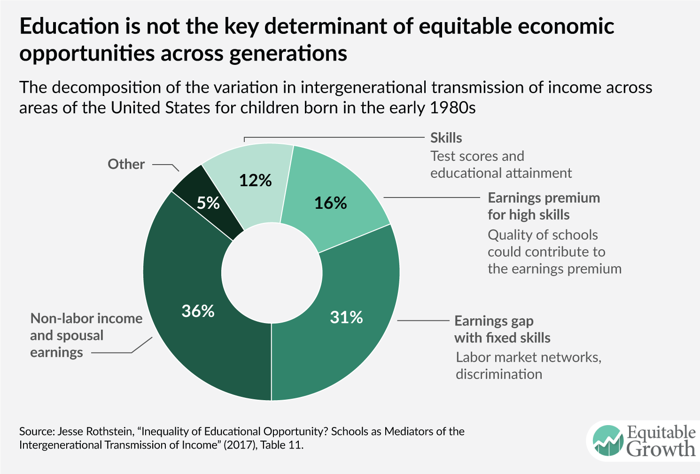
A new working paper authored by the UC Berkeley economist Jesse Rothstein builds on that research, in part by zeroing in on one of those five factors: schools. The idea that school quality would be an important element for intergenerational mobility—essentially a child’s likelihood that they will one day outearn their parents—seems intuitive: Leaders regularly stress that the best way to rise up the income ladder is to go to school, where one can learn the skills they need to succeed in a competitive, global economy. “In the 21st century, the best anti-poverty program around is a world-class education,” Barack Obama declared in his 2010 State of the Union address. Improving “skills and schools” is a benchmark of Republican House Speaker Paul Ryan’s poverty-fighting agenda.
Indeed, this bipartisan education-and-poverty consensus has guided research and political efforts for decades. Broadly speaking, the idea is that if more kids graduate from high school, and achieve higher scores on standardized tests, then more young people are likely to go to college, and, in turn, land jobs that can secure them spots in the middle class.
Rothstein’s new work complicates this narrative. Using data from several national surveys, Rothstein sought to scrutinize Chetty’s team’s work—looking to further test their  hypothesis that the quality of a child’s education has a significant impact on her ability to advance out of the social class into which she was born.
Rothstein, however, found little evidence to support that premise. Instead, he found that differences in local labor markets—for example, how similar industries can vary across different communities—and marriage patterns, such as higher concentrations of single-parent households, seemed to make much more of a difference than school quality. He concludes that factors like higher minimum wages, the presence and strength of labor unions, and clear career pathways within local industries are likely to play more important roles in facilitating a poor child’s ability to rise up the economic ladder when they reach adulthood.*
For Rothstein, there’s no reason to assume that improving schools will be necessary or sufficient for improving someone’s economic prospects. “We can’t educate people out of this problem,” he says.
His work, like Chetty’s, is not causal—meaning Rothstein is not able to identify exactly what explains the underlying variation in his economic model. Nevertheless, his work helps to provide researchers and policymakers with a new set of background facts to investigate, and signals that perhaps they should be reconsidering some of their existing ideas. (Both Raj Chetty and his co-author Nathaniel Hendren declined to comment for this story.)
Jose Vilson, a New York City math teacher, says educators have known for years that out-of-school factors like access to food and healthcare are usually bigger determinants for societal success than in-school factors. He adds that while he tries his best to adhere to his various professional duties and expectations, he also recognizes that “maybe not everyone agrees on what it means to be successful” in life.